

A compoundable offence is the only legal category where paying the victim can close FIR proceedings for good — get the category wrong, and repayment changes nothing.
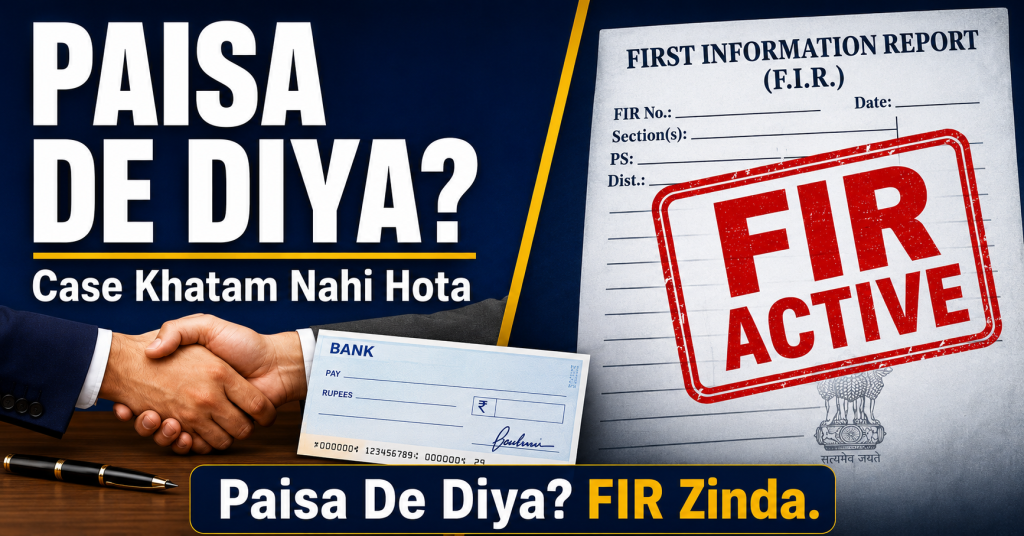
The myth that costs people their peace of mind: “I paid him back, so the police case is finished.”
No. Paying or settling with a complainant does not automatically close a criminal FIR. This is one of the most expensive misunderstandings in Indian criminal practice. Every month, people hand over money believing the case will simply dissolve and then receive a summons, a chargesheet, or worse, a conviction, years later. Whether a settlement can actually end a case depends on a single question: is the offence compoundable or non-compoundable? Everything else follows from that.
Let us break down what actually ends a criminal case, and what merely feels like it does.
Does Paying the Complainant Automatically End a Criminal Case?
A crime, in the eyes of the law, is not only a wrong against the individual victim it is treated as a wrong against society. That is why the State, not the complainant, prosecutes criminal cases. A private deal between two people cannot, by itself, undo a State prosecution.
The law does allow certain disputes to be “settled” formally, but only within a specific structure. That structure is compounding, and it is governed by Section 359 of the Bharatiya Nagarik Suraksha Sanhita, 2023 (BNSS) the provision that replaced Section 320 of the old CrPC when the new codes came into force on 1 July 2024. If an offence is not covered by that provision, no amount of money changes its legal status.
Compoundable vs Non-Compoundable: The Line That Decides Everything
Section 359 BNSS divides offences into three buckets:
Compoundable without court permission– minor offences where the parties can settle directly, and the compounding results in an acquittal. Examples include voluntarily causing simple hurt, criminal trespass, and defamation.
Compoundable with court permission– more serious offences that can still be settled, but only if the court agrees. This includes cheating under Section 318 BNS (earlier Section 420 IPC) and criminal breach of trust under Section 316 BNS (earlier Section 406 IPC).
Non-compoundable– Section 359(9) BNSS is blunt: “no offence shall be compounded except as provided by this section.” Anything not listed simply cannot be compounded, no matter what the parties agree. This bucket includes attempt to murder under Section 109 BNS (earlier Section 307 IPC), rape under Section 64 BNS (earlier Section 376 IPC), murder under Section 103 BNS (earlier Section 302 IPC), dowry death, POCSO offences, and offences under special laws like the Prevention of Corruption Act and the NDPS Act.
So if you are accused in a non-compoundable case, a private settlement however genuine does not, on its own, close the FIR. The case is still legally alive.
For Non-Compoundable Offences, Only the High Court Can Close FIR Proceedings
Here is where most people go wrong. They assume “settlement” and “closing the case” are the same event. They are not.
For a non-compoundable offence, the only route to actually end the case after a settlement is to approach the High Court under Section 528 BNSS (earlier Section 482 CrPC) and ask it to quash the FIR using its inherent powers. Quashing is not compounding. It is a discretionary judicial act, and the court applies a settled test before granting it.
That test comes from the Supreme Court’s landmark three-judge ruling in Gian Singh v. State of Punjab, (2012) 10 SCC 303 (decided 24 September 2012). The Court held that the High Court’s inherent power to quash is distinct from the statutory power to compound and that whether to quash on the basis of a compromise “depends on the facts and circumstances of each case.”
Where the dispute has a predominantly civil flavour commercial, financial, matrimonial, or property matters and the parties have fully settled, the High Court may quash to secure the ends of justice. But heinous and serious offences such as murder, rape and dacoity cannot be quashed even after a compromise, because they wound society, not just the individual.
Where Compromise Works and Where It Never Will
The line drawn in Gian Singh has been sharpened in case after case.
In Parbatbhai Aahir v. State of Gujarat, (2017) 9 SCC 641, the Supreme Court consolidated the principles, warning that the power to quash on settlement is not the same as compounding and must be used with care. In State of M.P. v. Laxmi Narayan, (2019) 5 SCC 688, the Court listed the factors a High Court must weigh: whether the crime is against society or the individual, the nature and gravity of the offence, and the stage of proceedings.
The most important recent boundary is Ramji Lal Bairwa v. State of Rajasthan, 2024 INSC 846 (Justices C.T. Ravikumar and Sanjay Kumar, 7 November 2024). A teacher accused of sexually assaulting a student had his FIR quashed by the High Court after settling with the victim’s father.
The Supreme Court set that aside, holding unequivocally that offences under the POCSO Act are heinous and impact society they cannot be quashed merely because the parties have compromised, and the fact that conviction has become “remote and bleak” is no ground to abruptly end the investigation. On the other end of the spectrum, B.S. Joshi v. State of Haryana, (2003) 4 SCC 675 confirmed that genuine matrimonial settlements can support quashing even of non-compoundable cruelty allegations.
The pattern is clear: your money buys nothing legally until a court applies this test and acts.
What You Should Actually Do After a Settlement
If you have reached a settlement in a criminal matter, protect yourself:
Record the settlement properly in writing, signed by both parties, ideally before a notary or as a court-recorded compromise. Then, if the offence is compoundable, file a joint compounding application before the trial court. If it is non-compoundable, file a quashing petition under Section 528 BNSS in the High Court, annexing the settlement, and get a formal order. Until that order comes, treat the FIR as fully active attend dates, cooperate with investigation, and do not assume you are free. And never pay in a case involving a child, sexual assault, corruption, or another heinous offence expecting the case to vanish it will not.
Where the Law Now Stands
Paying a complainant is not an exit door from a criminal case. Only two things legally end a case on settlement: valid compounding under Section 359 BNSS for eligible offences, or quashing under Section 528 BNSS by the High Court applying the Gian Singh framework. For heinous offences, no settlement will close the case at all. Understand which bucket your matter falls into before you part with a single rupee.
Frequently Asked Questions
No. Paying or settling with a complainant does not automatically close a criminal FIR. Whether a case ends on settlement depends on whether the offence is compoundable or non-compoundable under Section 359 BNSS (earlier Section 320 CrPC). For non-compoundable offences, the case remains legally alive until a court formally closes it.
Compounding is a statutory settlement of listed offences under Section 359 BNSS, resulting in acquittal. Quashing is a discretionary power of the High Court under Section 528 BNSS (earlier Section 482 CrPC) to end proceedings to secure the ends of justice. They are distinct: compounding follows a fixed list, while quashing is judged case by case.
Cheating under Section 318 BNS (earlier Section 420 IPC) is compoundable with court permission. Cruelty under Section 85 BNS (earlier Section 498A IPC) is generally non-compoundable, but the High Court may quash it on a genuine matrimonial settlement, as recognised in B.S. Joshi v. State of Haryana, (2003) 4 SCC 675.
No. In Ramji Lal Bairwa v. State of Rajasthan, 2024 INSC 846, the Supreme Court held that POCSO and sexual assault offences are heinous and impact society, and cannot be quashed merely because the parties have compromised. Heinous offences such as rape and murder cannot be closed on settlement.
Record the settlement in writing, then file a quashing petition before the High Court under Section 528 BNSS, annexing the settlement. The Court applies the test in Gian Singh v. State of Punjab, (2012) 10 SCC 303. Until the Court passes a quashing order, the FIR remains fully active and you must continue attending proceedings.