

Quick answer
- Once the accused admits signing the cheque, Sections 118 and 139 of the NI Act presume it was given to repay a legally enforceable debt, including a cash loan.
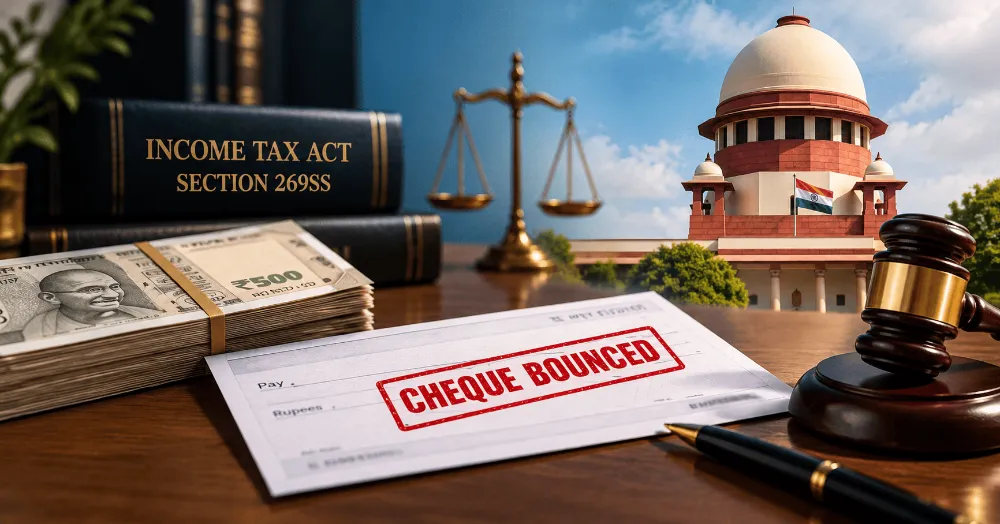
- Sanjabij Tari v. Kishore S. Borcar (2025 INSC 1158): a cash loan above ₹20,000 is still enforceable. Breaching Section 269SS of the Income Tax Act only attracts a tax penalty.
- A bare claim that the lender “had no money” is not a defence. The accused must produce real evidence.
- New Supreme Court directions: e-service of summons, a standard complaint synopsis, UPI payment at the first hearing, and cheaper early settlement (0% compounding fee before defence evidence).
Does lending money in cash to a friend or relative, and later suffering a bounced cheque, put you at a disadvantage in court? No — the Supreme Court has now made it explicit: once the accused admits signing the cheque, the law presumes it was issued to repay a real debt, cash or otherwise, and the burden shifts to the accused to prove otherwise with actual evidence, not bare denial.
This was settled decisively in Sanjabij Tari v. Kishore S. Borcar & Anr., 2025 INSC 1158, decided by the Supreme Court on 25th September 2025. The case is a common one dressed up as a legal dispute: a friendly cash loan, a cheque given in return, the cheque bounces, and the accused suddenly claims the complainant “never had the money” to lend in the first place.
What Happened in This Case?
The complainant advanced a cash loan of ₹6,00,000 to a friend, partly funded by his own father and a loan he had separately taken from a financial institution. The friend issued a cheque for repayment, which was dishonoured. Both the Trial Court and the Sessions Court convicted the accused under Section 138 of the Negotiable Instruments Act, 1881 (“NI Act”). The Bombay High Court (Goa Bench), however, acquitted the accused in an ex-parte revisional order accepting the argument that the complainant, earning a modest salary, could not have had the means to advance such a loan. The Supreme Court set this acquittal aside and restored the conviction, directing repayment of ₹7,50,000 in fifteen monthly instalments.
Does a Cash Loan Above ₹20,000 Become “Illegal” and Unenforceable?
No. The Kerala High Court had earlier held, in P.C. Hari v. Shine Varghese & Anr., 2025 SCC OnLine Ker 5535, that a cash loan above ₹20,000 which breaches Section 269SS of the Income Tax Act, 1961 is not a “legally enforceable debt,” so the Section 139 NI Act presumption would not apply. The Supreme Court expressly rejected this. Section 269SS breaches attract only a penalty under Section 271D of the IT Act; neither provision declares the underlying transaction void or illegal. A cash loan above ₹20,000, however imprudent from a tax-compliance standpoint, remains a legally enforceable debt for the purposes of Section 138 NI Act. This is directly relevant for businesses and individuals who have informally lent or borrowed cash and worry that the absence of a bank transfer weakens their legal position it does not.
What Presumptions Does the Law Make in a Cheque Bounce Case?
Once the accused admits signing the cheque, two presumptions arise automatically:
- Section 118 NI Act the cheque was made or drawn for consideration.
- Section 139 NI Act the holder received it in discharge of a legally enforceable debt or liability.
These are rebuttable, but the Court reaffirmed that the initial burden to raise a probable defence lies on the accused not on the complainant to first prove financial capacity (Bir Singh v. Mukesh Kumar, (2019) 4 SCC 197; Rangappa v. Sri Mohan, (2010) 11 SCC 441). The Court also noted that failure to reply to the statutory demand notice under Section 138 counts against the accused, since it suggests the defence was an afterthought (Tedhi Singh v. Narayan Dass Mahant, (2022) 6 SCC 735).
How Can the Accused Actually Rebut This Presumption?
Not by mere assertion. The Court was clear that a bald claim that the complainant “had no money” is not, by itself, a probable defence it must be backed by material: independent witnesses, bank records, or income-tax evidence, or by exposing weaknesses through cross-examination of the complainant’s own evidence. In this case, the accused led no evidence at all on the complainant’s alleged financial incapacity, and his story that a signed blank cheque was handed over merely to help the complainant get a bank loan was rejected as “unbelievable and absurd.”
What New Guidelines Has the Supreme Court Issued to Speed Up Cheque Bounce Cases?
Section 138 cases account for a staggering share of trial-court pendency nearly half of all pending trial-court matters in Delhi alone, as of 1st September 2025. To address this, the Court issued binding directions, including:
- Dasti and electronic service of summons in addition to usual modes, summons must now also be served by the complainant directly and via email/WhatsApp/SMS where particulars are furnished with an affidavit.
- A standard complaint synopsis every Section 138 complaint must now carry a structured cover synopsis (parties, cheque details, dishonour details, notice details, cause of action) immediately after the index.
- No summons before cognizance courts need not issue summons to the accused before taking cognizance under Section 223, BNSS.
- QR-code/UPI payment facility courts must set up secure digital payment links so an accused can pay the cheque amount at the very first hearing itself.
- Revised, graded compounding fee scale 0% if paid before defence evidence is recorded; 5% if paid before judgment; 7.5% before the Sessions Court/High Court; 10% before the Supreme Court (revising the older Damodar S. Prabhu v. Sayed Babalal H., (2010) 5 SCC 663 scale downward, given falling interest rates).
- Benefit of the Probation of Offenders Act, 1958 remains available to accused persons in Section 138 matters, since the offence is quasi-criminal in character (P. Mohanraj v. Shah Brothers Ispat (P) Ltd., (2021) 6 SCC 258).
- District-level pendency dashboards in Delhi, Mumbai and Kolkata, and monthly monitoring committees headed by the respective Chief Justices.
These directions are to be implemented by High Courts and District Courts by 1st November 2025.
What Should You Do If You’ve Lent Money on a Cheque or Are Facing a Section 138 Case?
For individuals who lend money informally: keep whatever proof you can WhatsApp messages, bank withdrawal slips, even an unsigned acknowledgment but know that the law now leans firmly toward honouring the cheque once the signature is admitted. For an accused person, silence is costly: always reply to the statutory demand notice, and gather concrete material (not just an oral denial) if you genuinely dispute the debt. For businesses, the new QR/UPI payment mechanism and the revised compounding scale mean faster, cheaper settlement is now realistically on the table at the very first hearing worth factoring into recovery strategy.
Where Does the Law Stand Now?
The presumption of a legally enforceable debt under Sections 118 and 139 of the NI Act remains strong and cannot be displaced by a bare denial including where the underlying loan was in cash. Alongside this, the Supreme Court has pushed the system itself toward faster resolution through structured complaints, digital service and payment, and a cheaper, earlier route to compounding.
Frequently Asked Questions
No. It may breach Section 269SS of the Income Tax Act, 1961, which attracts only a penalty under Section 271D it does not make the underlying loan void or unenforceable. The Supreme Court has expressly confirmed this in Sanjabij Tari v. Kishore S. Borcar (2025 INSC 1158).
Under Sections 118 and 139 of the Negotiable Instruments Act, 1881, the law presumes the cheque was made for consideration and issued to discharge a legally enforceable debt. This presumption arises automatically once the signature is admitted.
No. The accused must produce actual material such as bank records, income-tax evidence, or independent witnesses or expose weaknesses through cross-examination. A bare assertion is not treated as a probable defence.
Yes. The Supreme Court's revised guidelines allow compounding at 0% cost if paid before defence evidence is recorded, rising to 5%, 7.5%, and 10% of the cheque amount at later stages, up to the Supreme Court.
These include dasti and electronic service of summons, a standard complaint synopsis format, QR-code/UPI payment options in court, no summons required before cognizance, and district-level pendency dashboards.
Sources
- Negotiable Instruments Act, 1881 — Sections 118, 138 and 139
- Income-tax Act, 1961 — Sections 269SS and 271D
- Sanjabij Tari v. Kishore S. Borcar & Anr., 2025 INSC 1158 (Supreme Court, 25 September 2025)
- Rangappa v. Sri Mohan, (2010) 11 SCC 441
- Bir Singh v. Mukesh Kumar, (2019) 4 SCC 197
- Tedhi Singh v. Narayan Dass Mahant, (2022) 6 SCC 735
- Damodar S. Prabhu v. Sayed Babalal H., (2010) 5 SCC 663
- P. Mohanraj v. Shah Brothers Ispat (P) Ltd., (2021) 6 SCC 258